
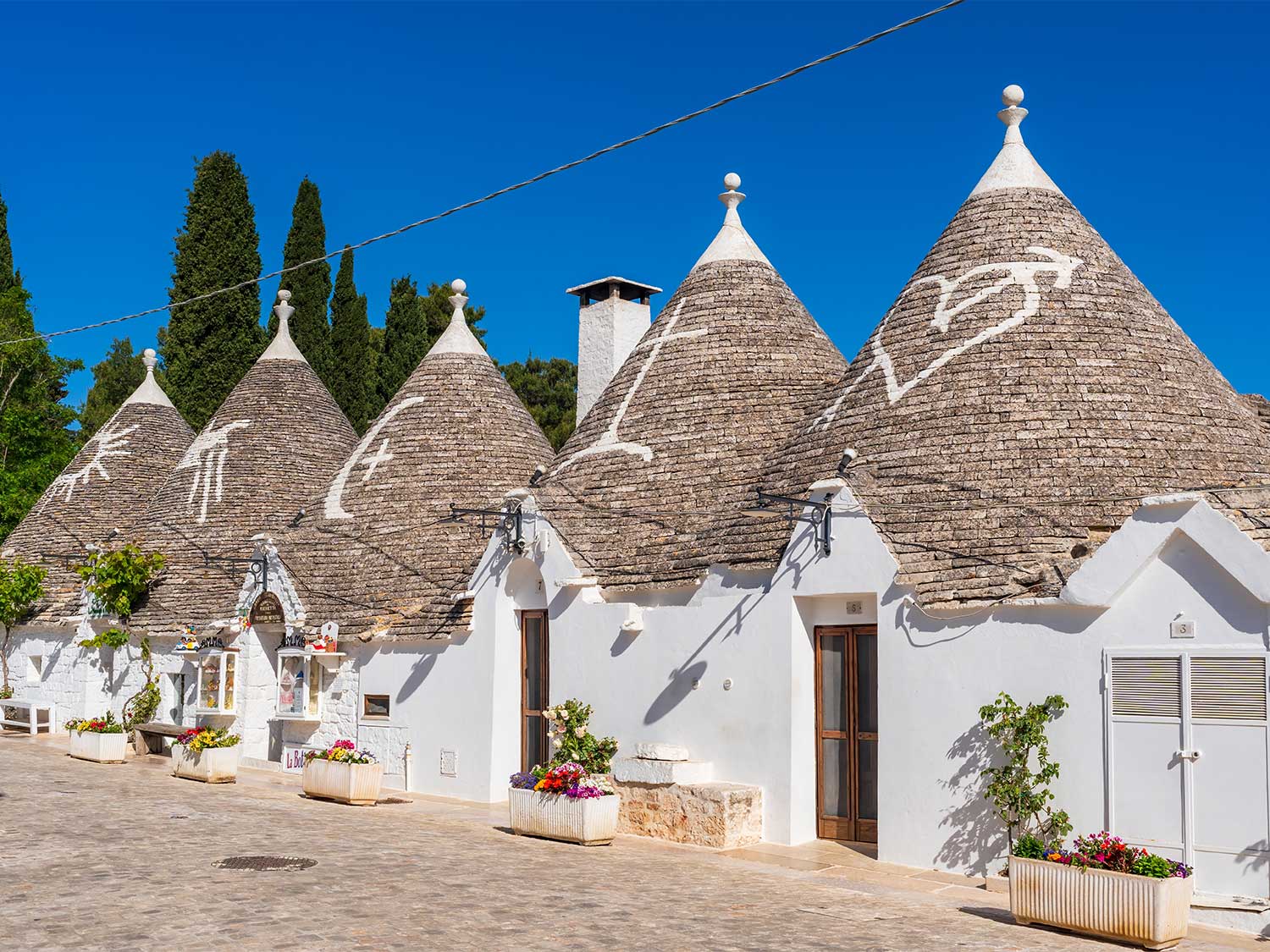
Heading to Italy’s stunning trulli country, Liz O’Reilly discovered some of the region’s most unique scenery.

I am a confirmed Italophile. From the language to the history, the almost universal love of dogs to the gorgeous scenery and, of course, the amazing food, I’ve yet to find anything about this European gem that I don’t like. That said, my visits have mostly been confined to the west, from Tuscany to Rome, down to my beloved Naples and south to Amalfi.
This time though, in celebration of a friend’s ‘big’ birthday, I was happily heading to Puglia, right down in the boot on the east coast, a land of ancient customs and olive trees. I have to admit that getting there was a bit of a faff, flying into Rome then grabbing a connecting hop to Bari. But, spoiler alert, it was totally worth it!
As one must when visiting Puglia, or Apulia, as it’s also known, we stayed in a converted trullo. And though it’s listed as an Airbnb, Trulli Ad Maiora was, honestly, like something out of a fairy tale. Trulli are distinctive dry stone buildings with conical rooves, often bearing mystical signs. The origins of the building method are pre-historic but the modern ones mostly date to the 19th century and they give the landscape around Alberobello, where the highest concentration is found, a truly magical quality.


Arriving at Ad Maiora, we could scarcely believe our eyes. Even before we entered our home for the next few days, the grounds were breathtaking. Coming from our arid region, it was a real treat to arrive to the scent of multiple blooms. From roses to numerous different species of lavender alongside flowering trees and plants we couldn’t immediately identify. We were told that the gardens and grounds hold 1,950 native plants as well as 45 ancient olive trees and there’s even an organic garden, from which we could pick fresh produce.
Butterflies and bees were in abundance, we adored just sitting watching them, and it felt like stepping into a little piece of paradise, even before we spotted our own large private pool, sauna and steam room and spa bath found in the secluded ‘Secret Garden’!
There was also a stone gazebo with a central table and outside kitchen for al fresco dining – Ad Maiora even offers a private butler service and the option to have a personal cooking class, which we took advantage of, making the most of the balmy weather to enjoy dinner under the stars. Inside, the six-cone complex was cool, thanks to the thick stone walls and underfloor cooling. My bedroom was simply gorgeous, the feeling of sleeping under one of those iconic conical structures just never got old and the adjoining bathroom with its pale honey stone and gushing shower felt like my own private sanctuary.


We could quite happily have spent all our time at the property but exploring was also on the menu and on our first full day, we headed into Alberobello town, just 1.5km away. The Unesco World Heritage Site is home to the region’s largest concentration of hundreds of trulli and we roamed the steeply rising streets of the Rione Monti district, where the whitewashed walls beneath their conical rooves house homes, shops, boutiques and restaurants. The area gives a real sense of history and, while the hillside trulli are beautifully preserved, we were also hugely impressed by the large, clean town square lined with restaurants, where we sampled local seafood and a refreshing spritz.
We also visited Ostuni, known as La Città Bianca or The White City for its whitewashed houses. Heading to a local market, we marvelled at the huge selection of fresh fruit and vegetables; tomatoes ripened under the Italian sun and rich aromatic cheeses definitely caught our eyes. Then it was time to head upwards again, through the old city’s narrow, winding streets. Mediaeval alleys and courtyards gave the whole area an atmospheric feel, as if we’d almost stepped back in time, and it’s worth noting that local bylaws are quite strict to make sure the city’s unique feel is preserved.
After a couple of days of sight-seeing, we were ready for an evening at ‘home’. Enter Chef Carmela, who came to Trulli Ad Maiora to help us make the most of that gorgeous outdoor dining space. Handing each of us an apron, she demonstrated how to make Orecchiette, the region’s traditional ‘little ear’ pasta, then set us to work as we helped her prepare succulent, spicy meatballs. That evening’s meal, under a glowing sky and gleaming garden chandelier, became one of the prized memories of our stay.


The following night, it was time for the big birthday dinner at Graecalis, a rather fancy fish restaurant in nearby Polignano a Mare, kindly recommended by our host. We sat outside amid the scents of the Italian countryside, our table in a stunning setting neighbouring an ancient olive grove with fairy lights strung overhead, where we enjoyed some of the best seafood I have tasted in a very long time. Big, juicy prawns, superbly fresh and adorned with local herbs in a bisque I could have eaten just on its own. My dining companions shared a locally-caught lobster, which they declared superb.
On our last day, we headed to the coastal town of Monopoli to explore the Baroque cathedral and its ancient tombs
Read more from original article, all rights reserved Travel Review: Discovering The Wonders Of Puglia
Leave a Reply